Thursday, April 21, 2011

Hell-Volhard-Zelinsky reaction

The Hell-Volhard-Zelinsky involves the halogenation of carboxylic acids at the alpha carbon of the carbonyl group.  The basic reaction reacts as such:

The first step in the mechanism of this reaction involves the substitution of a bromide on the hydroxyl(OH) group of the carboxylic acid.  The catalyst PBr3 causes this bromide to replace the OH group which causes the formation of the carboxylic acid bromide.  The present acyl bromide is then tautomerized to form an enol which reacts with the Br2 which creates the second placement of a bromide on the compound.  The following depicts the mechanism of this reaction:


An example of a synthesis where this Hell-Volhard-Zelinsky mechanism is used is in the formation of dimethylketene.  In this synthesis the starting reactant is isobutyric acid which then reacts with PBr2 to form the product of propanoyl bromide or a-bromoisobutyryl bromide.  This product is then reacted with zinc and some heat and results in the overall final product of dimethylketene.  The Hell-Volhard-Zelinsky mechanism is used in the first step of the reaction.  The steps in this reaction are:
The Hell-Volhard-Zelinsky reaction of a halogenation of carboxylic acids at the alpha carbon is named after three chemists.  Their names are Carl Magnus von Hell ( German chemist), Jacob Volhard (German chemist) and Nikolay Zelinsky who was a Russian chemist.  This reaction is being discussed in the Organic Chemistry 2 class at Campbellsville University.


Sources:
1.  "Hell-Volhard-Zelinsky Halogenation." Wikipedia, the Free Encyclopedia. Web. 21 Apr. 2011. http://en.wikipedia.org/wiki/Hell-Volhard-Zelinsky_halogenation.
2.  Organic Syntheses Website. Web. 21 Apr. 2011. http://orgsyn.org/orgsyn/default.asp?formgroup=basenpe_form_group.

Sunday, April 10, 2011

Methyl trans-Cinnamate

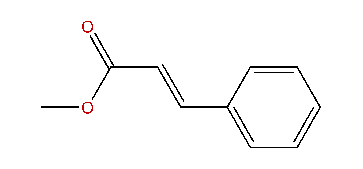
Methyl trans-cinnamate is the methyl ester of cinnamic acid.  Methyl trans-cinnamate gives off the appearance of a white to light yellow fused crystalline mass with a strong, aromatic odor.  It is found naturally in a variety of plants and fruits, most specifically strawberries.  It is mostly used in the fragrant and flavor industries as an agent for perfumes and such.  The structure for methyl trans-cinnamate is:
The properties of Methyl trans-cinnamate:
   - Melting Point: 260-262°C
   - Boiling Point: 34-38°C
   - Water Solubility: Insoluble
   - Molecular Weight: 162.19 g/mol
   - Linear Formula: C6H5CH=CHCO2CH3
   - IUPAC name: Methyl (E)-3-Phenylprop-2-enoate

The carboxylic acid the ester is derived from is:
An example of one reaction where methyl trans-cinnamate is converted to another derivative:

Sources:

1. "Methyl Cinnamate." Chemical Book. Web. 9 Apr. 2011. http://www.chemicalbook.com/ChemicalProductProperty_EN_CB5206328.htm.
2.  Methyl Cinnamate." Wikipedia, the Free Encyclopedia. Web. 9 Apr. 2011. http://en.wikipedia.org/wiki/Methyl_cinnamate.
3.  "Cinnamic Acid | RM.com ®." Magick, Wicca, Paganism and Other Esoteric Knowledge | RM.com ®. Web. 9 Apr. 2011. http://www.realmagick.com/cinnamic-acid/.

Sunday, April 3, 2011

Methyltriisopropoxytitanium

Methyltriisopropoxytitanium is the product of the reaction of titanium tetraisopropoxide in ether and of titanium tetrachloride.  Methyllithium in ether is then added to the cooled reactants to produce the final product, Methyltriiopropoxytitanium.  The IUPAC name for this final product is methyltitanium triisopropoxide.  The newly formed carbon-carbon bonds is the methyl group located on the titanium ion. 

The reaction scheme for this reaction is listed below for A. :

1

In a reaction involving an organolithium reagent the organometallic compound has a bond between a carbon and a lithium atom.  Since lithium is very electronegative, the charge of the overall bond is placed on the carbon atom which creates a carbanion.  For this reaction, A, the only step of the reaction involves the organolithium reagent acting on the titanium atom and forming the newly bonded Ti-C bond.  The first reactant for the reaction is an organotitanium compound. This product of Methyltriiospropoxytitanium is extremely flammable liquid and vapor and can cause severe eye and skin irritation.  The target organs for this compound are the respiratory system and eyes.  This overall reaction of Methyltriisopropoxytitanium involves an organolithium reagent which alters the overall product.  2

Source
1. "Organic Syntheses Prep." Organic Syntheses Website. Web. 03 Apr. 2011. http://orgsyn.org/orgsyn/prep.asp?prep=v81p0014.
2. MSDS Methyltitanium(IV) Triisopropoxide, 1M Solution in THF CAS 18006-13-8 MSDS Methyltris(isopropoxy)titanium(IV)." MSDS & Custom Synthesis Organic Synthesis Bio-Synthesis Suppliers. HBCChem. Web. 03 Apr. 2011. http://www.chemcas.org/drug/analytical/cas/18006-13-8.asp.

Thursday, March 24, 2011

Aspartic Acid

  Aspartic acid is a non-essential and acidic amino acid.  Aspartic acid is abbreviated as Asp or D.  Aspartic acid was first recognized in 1868 when it was first isolated from legumin in plant seeds.  Aspartic acid is a non-essential amino acid for mammals which means that enough aspartic acid is synthesized by the body from oxaloacetic acid which is formed in metabolism of carbohydrates.  Aspartic acid is found in many different sources of food such as dairy, beef, poultry and sprouting seeds.  Here is a high quality representation of the structure of aspartic acid:

  Aspartic acid's molecular formula is C4H7NO4 and has a molecular weight of 133.10 grams/mole. Aspartic acid is the one of only two amino acids that give a negatively charged carboxylic group on the side chain.  The functional groups present within aspartic acid are an amine and two carboxylic groups.  Aspartic acids are play a vital role as acids in enzyme active centers and also function in maintaining the solubility and ionic character of proteins.  This amino acid is one of the only two acidic amino acids.  There are three pKa values for aspartic acid which are: 1) alpha-carboxylic - 2.10;   2) alpha-amino -  9.82;  3) side chain  -  3.86.  The side chain is a carboxyl group located on the amino acid.  The isoelectric point for aspartic acid is 2.77 pH. 
 
Sources:
1.  Mayer, Michael. "Aspartic acid information page. All about aspartic acid and the role it plays in your diet." Zest for Life vitamins and supplements. 24 Jan. 2011. 24 Mar. 2011 http://www.anyvitamins.com/aspartic-acid-info.html.

2.  Kirste, Burkhard. "Aspartic Acid." Institut für Chemie und Biochemie an der FU Berlin. 23 Jan. 1998. 24 Mar. 2011 http://www.chemie.fu-berlin.de/chemistry/bio/aminoacid/asp_en.html.

3.  "Amino Acids - Aspartic Acid." The Biology Project. 24 Sept. 2003. 24 Mar. 2011 http://www.biology.arizona.edu/biochemistry/problem_sets/aa/aspartate.html.

4.  Parrill, Abby. "Amino Acid Structures." Michigan State University. 4 Feb. 1997. Department of Chemistry. 24 Mar. 2011 http://www.cem.msu.edu/~cem252/sp97/ch24/ch24aa.html.

Sunday, March 6, 2011

Ibuprofen

  The fourth blog assignment was to find an article containing a synthesis of a common drug and to list any of the Electrophilic Aromatic Substitution reactions in the synthesis.  After thoroughly looking through many websites and journals I finally found an article that had a synthesis for a common drug and that drug is...IBUPROFEN!
  Ibuprofen is an over the counter drug which is used to relieve pain of symptoms of arthritis, fever and other occurrences for pain relief.  It was developed in the 1960s and was discovered by Steward Adams in 1961 and also patented in the same year.  Ibuprofen functions as an inhibitor for an enzyme that directs formation of several mediators of inflammation.
  There are five steps in the synthesis of ibuprofen.  The first step is the electrophilic aromatic substitution step where a Friedel-Crafts acylation occurs. The isobutyl group is a ortho and para director and a benzene activator.  However, the para isomer is formed because there is steric hindrance on the ortho isomer.  The next few steps involve the reduction of the ketone to an alcohol, then conversion of alcohol to a chloro group, then the chloro group is substituted by a cyano group.  The last step involves the hydrolysis of the cyano compound to achieve the final product of ibuprofen.  Listed below is the synthesis:


  The site were the article can be found is:
    http://www.pharmainstitute.in/archives.htm  on the May 2008 issue
Hope this is interesting and allows you to understand electrophilic aromatic substitution in a different way with an actual synthesis of a common everyday drug.

Thursday, February 24, 2011

Granny's Rendition of Aromatic Compounds

   Aromaticity is a chemical property that compounds are listed as if they qualify for the four criteria that are listed such as it must be cyclic, planar, completely conjugated and have 4n + 2 pi electrons.All aromatic compounds are based off of the basic benzene ring which is a ring with six sides and six carbons and six hydrogens.  The first criterion is that the molecule must be cyclic which means that it must be shaped like a ring or in a circle to be an aromatic compound.  The second criterion is that the molecule must be planar which means that the compound needs to be flat like a piece of paper to be aromatic.  For example, if the structure of the compound is shaped as a tub with some parts higher than others then it is not planar. 
   The third criterion is that a molecule must be completely conjugated which means that these compounds must have a p orbital on every atom.  For example, if you have a 6-sided ring, you will need three double bonds with the double and single bond followed by another double bond and so on.  The last criterion is that a molecule must satisfy Huckel’s rule and contain a particular number of pi electrons.  The particular number of pi electrons must meet the 4n + 2 pi electron rule.  For instance, if you use something like pencils you can have 2, 6, 10, etc. because n equals 0, 1 and 2.  Hope this helps clear up how to distinguish aromatic compounds from nonaromatic ones.

Wednesday, February 9, 2011

Exam Uno Questions

After taking the first Organic Chemistry exam, I wondered why there was not a question that required us to label and count the number of 1H NMR signals for different compounds.  After working hard and completing the Sapling homework I fully understood and knew I was able to answer these questions.  On Sapling, there were a few questions that covered this portion of Organic Chemistry.  When the exam was handed out I was confused on why there wasnt any of these choices of questions on there.  The correct way to answer these types of questions is to make sure to understand that the number of NMR signals equals the number of different types of protons in a compound.  The main principle of finding the number of signals is that protons in different environments give different NMR signals.  The same NMR signals are given by protons being equivalent to each other.  For example, a compound such as CH3OCH3 has only one 1H NMR signal.  The reasoning for this is that each methyl group CH3 is bonded to the same group which makes both methyl groups have the same signal.  However, for a compound such as CH3CH2Cl there are two different signals because the hydrogens are two carbons away from the chlorine for one signal and for the other signal the hydrogens are located one carbon away.  After working on the sapling problems and reading over this section in the book I was confident that I would be able to complete a question on the number of 1H NMR signals.  However, since there was not a question on the exam containing this subject I was a little confused but this is still a great part of Organic Chemistry that needs to be understood.